The Biggest Stocks in the World Are Down. The Market Isn’t. Here’s Why.
Energy +26%. Small caps beating the Nasdaq by the widest margin in decades. The Great Rotation is here.

Charlie Chan
March 06, 2026
The biggest companies in the world are down this year. Microsoft, negative 19%. Amazon, negative 13%. Tesla, negative 12%. The Magnificent Seven as a group are down about 5%.
But the market? The S&P 500 is basically flat. And some parts of it are quietly surging.
Energy stocks are up 26%. Industrials, up 14%. Consumer staples, up 12%. Small caps are beating the Nasdaq by the widest margin in decades.
They’re calling it the Great Rotation - capital flowing out of the mega-cap tech stocks that dominated the last decade and into sectors most people stopped paying attention to years ago.
This isn’t a small shift. It might be the most important market move since the dot-com bust. Here’s what the data actually shows.

The Scoreboard
Winners | YTD 2026 | Losers | YTD 2026 |
|---|---|---|---|
Energy (XLE) | +26.4% | Microsoft | -18.6% |
Industrials (XLI) | +13.6% | Amazon | -12.9% |
Consumer Staples (XLP) | +11.9% | Tesla | -11.7% |
Utilities (XLU) | +10.5% | Nvidia | -3.5% |
Value (VTV) | +8.5% | Nasdaq 100 (QQQ) | -1.0% |
Sources: StockAnalysis, FinancialContent, Motley Fool, Barchart. Data as of early March 2026.
The S&P 500 equal-weight index - where every company gets the same allocation instead of letting the Mag Seven dominate - is up 5%. It’s outperforming the regular cap-weighted S&P by five points. That’s the single clearest signal that the market is broadening out.
Record $29 billion flowed into sector ETFs in January - the best start to any year ever. Bank of America says institutions are now the most overweight small caps versus large caps since April 2021.
The Concentration Problem You Didn’t Know You Had
If you own the S&P 500 through an index fund - SPY, VOO, whatever - seven stocks make up a third of your entire portfolio. The Magnificent Seven are 33% of the index. That’s up from 12% in 2016.
Year | Mag 7 Weight in S&P 500 |
|---|---|
2016 | ~12.5% |
2024 Peak | ~35% |
March 2026 | ~32.7% |
So when the market returns 1% but the Mag Seven are down 5%, the other 493 stocks are doing much better than you think. And if you own QQQ or individual tech names on top of your index fund, you might be 50%+ in tech-adjacent sectors without realizing it.

The Small Cap Story Nobody’s Paying Attention To
The Russell 2000 is up 5.3% this year. The Nasdaq 100 is down 1%. That’s a 6+ point gap in just two months.
Small caps just put together a 14-session winning streak against the S&P 500 - the longest since 1996. But here’s the insight most people miss: the headline Russell 2000 P/E ratio is 33x, which looks expensive. But the value subset of the Russell 2000 trades at just 11x earnings - 26% below its 20-year average.
The rotation isn’t into all small caps. It’s specifically into small cap value. And small cap value is genuinely cheap.
Why now? Four reasons:
Domestic revenue - small caps earn most of their money in the US, making them less exposed to trade wars and tariff uncertainty
Rate cuts - the Fed has cut to 3.5%. Small companies carry more floating rate debt, so lower rates directly improve their bottom line
Faster earnings growth - Russell 2000 expected to grow earnings 19% this year versus 12.5% for the S&P 500
Valuation gap - small caps entered 2026 at a 31% discount to large caps. That kind of gap has historically preceded multi-year outperformance
(Sources: Siblis Research, CME Group, Kavout, BofA Global Fund Manager Survey)

Six Catalysts That Hit at Once
This rotation isn’t happening because of one thing. Six catalysts converged at the same time - each one on its own might not be enough, but together they created the conditions for a major shift.
1. SCOTUS tariff ruling - The Supreme Court struck down the IEEPA tariffs 6-3. Effective tariff rate dropped from 17% to 9%. Removed a massive overhang from consumer and import-dependent sectors.
2. Rate cuts - Three cuts in late 2025, two more expected this year. Lower rates favor small caps, value stocks, and rate-sensitive sectors like utilities and real estate.
3. AI spending fatigue - The Mag Seven are spending $700 billion on AI infrastructure this year - up 60% from 2025. The market is starting to ask: where’s the return? Microsoft’s $37 billion quarterly AI spend spooked investors. Capital is rotating from AI builders to AI adopters.
4. Earnings broadening - For the first time since 2021, all 11 S&P 500 sectors are posting positive earnings growth. Industrials grew 26% last quarter. The gap between the Mag Seven and the other 493 companies is closing fast.
5. Geopolitical energy premium - The Iran conflict pushed oil above $79/barrel. Energy majors rallied hard. This structurally supports the energy sector that’s leading the rotation.
6. Valuation mean reversion - The equity risk premium is near zero - the lowest on record. Growth stocks are offering almost no compensation for risk versus bonds. That’s pushing capital toward value.
(Sources: Yale Budget Lab, FactSet Earnings Insight, Morgan Stanley, CNBC)
Has This Happened Before?
Three times in recent history.
Period | Duration | What Happened |
|---|---|---|
2000 Dot-Com Bust | ~7 years | Small-cap value returned +19% in 2000 while the Nasdaq fell 78%. Value outperformed growth through 2006. |
2016 Trump Trade | ~1 week | Financials and industrials surged post-election. Then underperformed for the remaining 3 years and 51 weeks of the term. |
2021 Reopening | ~5 months | Russell 2000 gained 50% vs Nasdaq’s 22%. Reversed by summer as “transitory” inflation took hold. |
Which one does 2026 look like? The evidence points closer to the 2000 multi-year cycle than the short-lived 2016 or 2021 trades. In those cases, the rotation was driven by sentiment and expectations. In 2026, it’s driven by actual earnings growth broadening and structural policy changes. The SCOTUS ruling isn’t a tweet - it’s a Supreme Court precedent.
Morgan Stanley’s chief strategist says he’s the most bullish on small caps since March 2021. Goldman Sachs sees a broadening bull market. Bank of America is recommending increased small-cap exposure.
But the honest counterpoint: Goldman also says the Russell 2000 may not meaningfully outperform the S&P 500 over the full year. And Capital Economics warns this could be late-cycle distribution - the kind of pattern you see before bubbles burst, not after.
(Sources: Alpha Architect, Goldman Sachs 2026 Outlook, Morgan Stanley, Fortune/Capital Economics)

What to Actually Do
Step 1: Check your real exposure. Log into your brokerage, look at the sector breakdown. If your tech-adjacent allocation exceeds 50%, you’re significantly overweight the losing side of this rotation.
Step 2: Tactical tilts, not dramatic shifts. This is a rebalancing, not a fire sale. The Mag Seven are still growing earnings 17-23%. They’re not broken companies.
A reasonable approach:
Trim 5-10% from mega-cap tech overweight
Add 3-5% to value (VTV, RSP)
Add 2-5% to small cap value (IWN, AVUV)
Consider 2-3% in international markets
Step 3: Collect the income. When you rotate from growth to value, you’re not just making a capital appreciation bet. You’re collecting significantly more income.
Sector/ETF | Dividend Yield |
|---|---|
Energy (XLE) | 4.57% |
Financials | 4.17% |
Utilities | 3.96% |
Value (VTV) | 1.91% |
Nasdaq 100 (QQQ) | 0.46% |
That’s a 10x difference between energy and the Nasdaq. Moving $10,000 from QQQ to energy generates roughly $400 more in annual income. You get paid to wait while the rotation plays out.

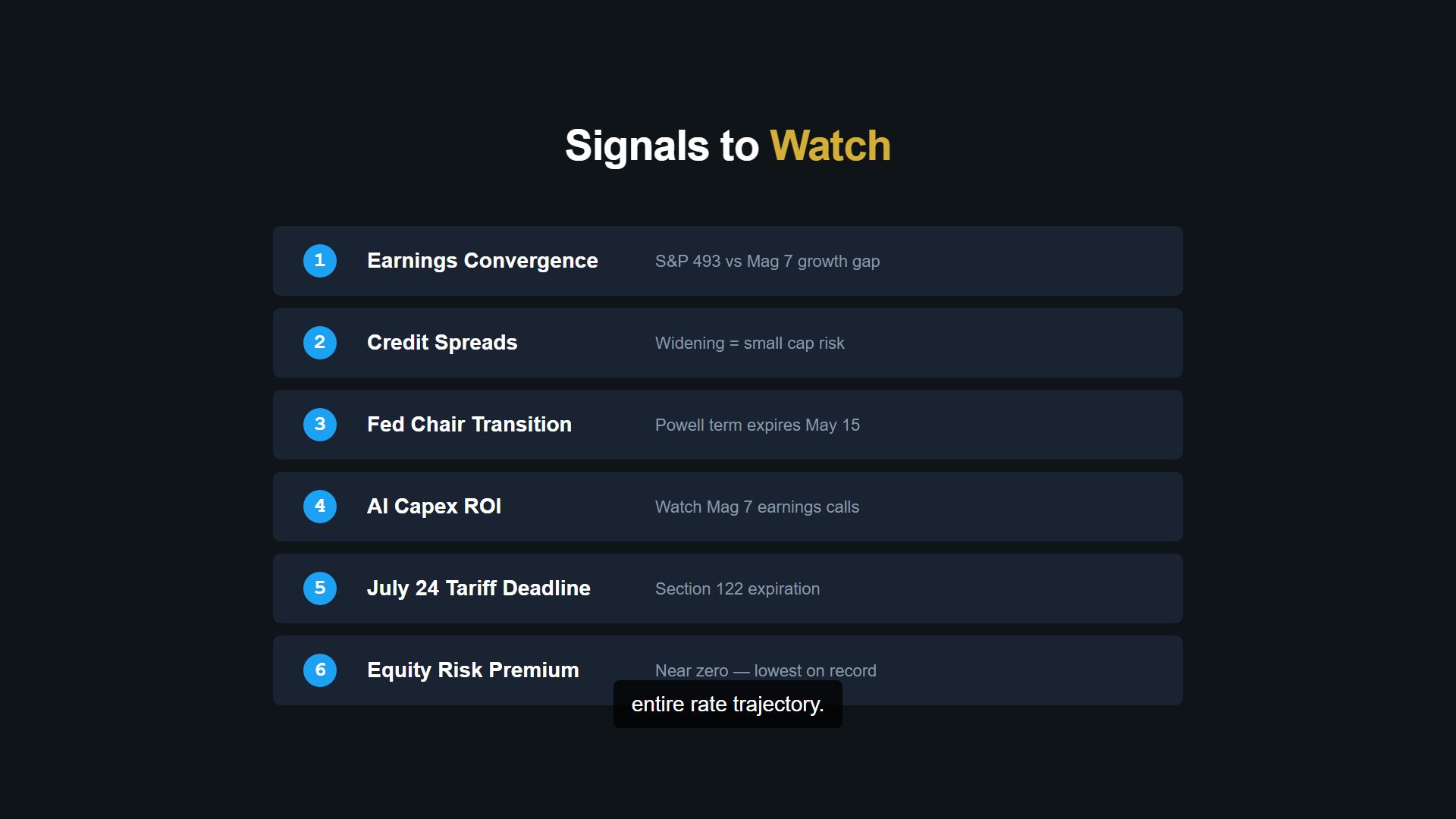
Six Signals to Watch
These will tell you if the rotation has legs or is about to reverse:
Earnings convergence - if the gap between Mag Seven and S&P 493 earnings growth keeps closing, the rotation continues
Credit spreads - if investment grade spreads start widening, small caps get hit first
Fed chair transition - Powell’s term expires May 15. A new chair could shift the entire rate trajectory
AI capex returns - next round of Mag Seven earnings will reveal whether $700B in spending is generating real revenue
July 24 tariff deadline - if Section 122 tariffs expire without replacement, that’s another catalyst for consumer stocks
Equity risk premium - currently near zero. Any normalization favors value over growth
Bottom Line
The market is telling you something right now. Concentration doesn’t last forever. Earnings growth matters more than narratives. And the boring sectors just got a lot less boring.
Whether this rotation lasts 5 months or 7 years depends on whether the earnings broadening is real and sustained. The early evidence says it is. But the honest answer is: nobody knows for certain.
What you can do is check your actual exposure, consider whether a 33% allocation to seven stocks still makes sense, and know what signals to watch.
This is not investment advice. Do your own research.
Enjoyed this issue?
Subscribe to get new insights delivered to your inbox.
Join the newsletter
An investor's notebook. The research, the conviction, and the bets behind every position.
No spam. Unsubscribe anytime.